

Most people who walk into a hospital are carrying more than a diagnosis. There is the condition itself — the blood reports, the scan findings, the numbers that need to come down or go up. And then there is everything underneath that. The anxiety about what it means. The lifestyle that contributed to it. The emotional weight of being unwell in a life that does not pause for illness.
Conventional medicine handles the first part well. The Department of Integrated Medicine at Bhaktivedanta Hospital and Research Institute was built to handle both.
What Integrated Medicine Actually Is
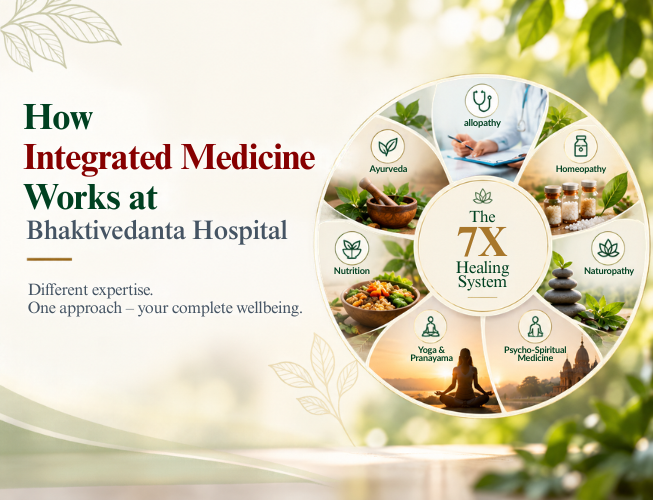
Integrated medicine is not alternative medicine. It does not replace modern diagnosis or evidence-based treatment. What it does is bring several healing systems into the same room — Allopathy, Ayurveda, Homeopathy, Nutrition, Psycho-Spiritual Medicine, Yoga and Pranayama, and Naturopathy — and use whichever combination genuinely serves the patient in front of them.
The department calls this the 7X Healing System. Seven dimensions of care. Different expertise, one intention — the patient's complete wellbeing.
Each modality contributes something the others cannot fully cover alone. Allopathy provides acute care, accurate diagnosis, and emergency management. Ayurveda brings tri-dosha balancing, pulse reading through Nadipariksha, and preventive lifestyle guidance. Homeopathy works on gentle constitutional correction. Nutrition addresses cellular and hormonal repair. Psycho-Spiritual Medicine explores how faith, purpose, and inner strength shape pain and healing outcomes. Yoga and Pranayama reset the autonomic nervous system. Naturopathy optimises health through natural therapies, rest, and stress management.
Together, they address what a single speciality rarely can — the root cause.
The 5 Step Care Model
What makes this department function differently from a general OPD is the structure underneath it. Every patient goes through a five-step integrated care model.
It begins with a detailed assessment — not just symptoms and vitals, but lifestyle, diet, sleep quality, mental health, family history, personal habits, occupation, and spiritual wellbeing. This takes time deliberately. Because you cannot identify the root cause of something without understanding the full context it grew in.
Step two is a team discussion — a multidisciplinary review where risk factors and underlying contributors are identified together rather than in isolation. Step three is individualised treatment, built around three pillars: Ahar (diet), Vihar (lifestyle), and Aushadh (medicines). Step four addresses comorbidities — the additional conditions that complicate recovery, including things like chronic pain, poor sleep, stress, and childhood patterns that show up in adult health. Step five is long-term impact — holistic healing by addressing root causes and improving quality of life over time.
This is not a protocol applied uniformly. It is a process built around a specific person.
The Cases That Make This Department Necessary
Two kinds of patients particularly benefit from what integrated medicine offers — and both are more common than people realise.
The first is young adults who have had a significant cardiac event. A PTCA — a procedure to open a blocked coronary artery — changes a person's life in ways that go far beyond the procedure itself. The physical recovery is one part. The psychological aftermath is another entirely. Young patients especially — people in their thirties and forties who did not expect to be in this situation — often leave the cardiology ward without adequate support for the fear, the grief, the complete reassessment of how they were living. Integrated medicine provides that counselling, that lifestyle restructuring, and that ongoing support in a way that cardiology alone is not designed to.
The second is post-cancer patients. The treatment may be complete but the person is not the same. Fatigue, hormonal disruption, emotional fragility, fear of recurrence, a body that needs rebuilding — these are not addressed by discharge papers. Integrated medicine creates a structured recovery pathway for physical restoration and emotional healing, because both matter equally to what comes next.
In both situations — and across the full range of chronic and complex conditions the department supports — the approach is the same. Find the root cause. Address the whole person. Build health that lasts.
The Department of Integrated Medicine at Bhaktivedanta Hospital and Research Institute is located at Bhaktivedanta Swami Marg, Sector 6, Srishti Complex, Mira Road East. For appointments call 079-69002222 or reach the team through Ask Bhakti on 8400 14 6262.
FAQ
What is integrated medicine and how is it different from conventional treatment?
Integrated medicine combines modern allopathic care with evidence-informed healing systems including Ayurveda, Homeopathy, Nutrition, Yoga, Naturopathy, and Psycho-Spiritual Medicine. It does not replace conventional diagnosis or treatment — it addresses the root cause of disease and the complete wellbeing of the patient alongside it.
What conditions does the Department of Integrated Medicine at Bhaktivedanta Hospital treat?
The department supports a wide range of conditions including diabetes, hypertension, cardiovascular risk, cancer after-care, chronic joint and musculoskeletal conditions, stress and anxiety, sleep disorders, digestive disorders, hormonal imbalances, chronic fatigue, and chronic pain. It also provides post-procedure counselling and lifestyle restructuring for cardiac patients.
Why do young cardiac patients need integrated medicine support after PTCA?
A cardiac event and subsequent procedures like PTCA create significant psychological and lifestyle challenges — particularly for younger patients who were not expecting such a diagnosis. Integrated medicine provides structured counselling, emotional support, and personalised lifestyle guidance to support recovery that goes beyond the physical procedure.
How does integrated medicine help post-cancer patients?
After cancer treatment ends, patients often deal with fatigue, hormonal disruption, emotional distress, and fear of recurrence. The department creates a structured recovery pathway addressing both physical restoration and emotional healing — supporting the whole person through what comes after treatment, not just during it.
What is the 7X Healing System at Bhaktivedanta Hospital?
The 7X Healing System refers to seven dimensions of integrated healing — Allopathy, Ayurveda, Homeopathy, Nutrition, Psycho-Spiritual Medicine, Yoga and Pranayama, and Naturopathy. Each modality contributes a distinct form of care, working together under one treatment plan personalised to the individual patient.