
Surgery is one of those words that still makes people stop. Not because it is unfamiliar — but because of everything that comes with it in the imagination. The cut. The weeks of not being able to move properly. The scar that stays. The time away from everything that cannot wait for you.
That picture is not wrong. It just describes surgery as it used to be. What it looks like now at Bhaktivedanta Hospital and Research Institute is a different story.
Three Ways to Operate. Very Different Outcomes.
Most people do not realise there is a spectrum here. Surgery is not one thing — it is several, and where a procedure falls on that spectrum changes everything about the patient's experience.
Conventional open surgery gets the job done — but the body pays for it. Large incision, significant tissue trauma, visible scarring, more blood loss, more pain, and a recovery that stretches into weeks.
Laparoscopic surgery moved things forward. Small incisions, a camera, specialised instruments — already a real improvement. But the instruments move in restricted directions. Fine movements get harder. In tight anatomical spaces the access gets complicated and the visual system offers limited magnification.
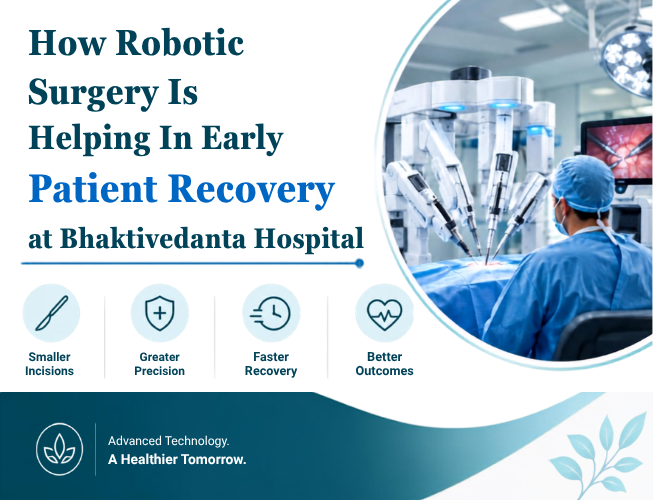
Robotic-assisted surgery addresses those gaps. The surgeon works from a console controlling robotic arms that translate hand movements into precise micro-level actions. The instruments handle surrounding tissue more gently. The visual system is high-definition 3D with magnification that lets the surgeon see detail that neither open nor laparoscopic surgery provides clearly.
For the patient: smaller incisions, minimal scarring, less blood loss, less pain, shorter hospital stay, faster return to normal life.
What Is Available at Bhaktivedanta Hospital
Robotic-assisted procedures at Bhaktivedanta Hospital run across five specialties.
Urology — prostate surgery, kidney procedures, urological cancers where precision in confined spaces is critical. Oncology — cancer surgeries where the margin between tumour and healthy tissue demands accuracy that conventional instruments cannot always guarantee. General Surgery — complex abdominal work, hernia repair, gastrointestinal procedures where minimally invasive access changes the recovery trajectory. Gynaecology — hysterectomy, fibroid removal, gynaecological cancer cases where delicate tissue handling is essential. Paediatric Surgery — where smaller anatomical spaces make robotic precision specifically valuable.
Until recently this combination of technology and expertise was available only at select tertiary centres. That is no longer the case for patients in Mira Road and surrounding areas.
What Actually Changes for the Patient
Fear of recovery stops a lot of people from moving forward with surgery they genuinely need. The scar, the pain, weeks away from work or family — with conventional surgery these were justified concerns.
That calculation shifts with robotic minimally invasive surgery. Faster recovery is not a promise — it is a clinical outcome that shows up consistently across procedure types. The hospital stay shortens. Pain afterward is less. Precision during the procedure tends to reduce complications in the days that follow.
Robotic surgery is not the right answer for every patient or every condition though. The anatomy, complexity of the case, overall health — these determine the most appropriate approach. That decision happens during a proper consultation, not before it.
At Bhaktivedanta Hospital and Research Institute, robotic-assisted surgery is available across Urology, Oncology, General Surgery, Gynaecology, and Paediatric Surgery. If an operation has been recommended and you want to understand what the least invasive option looks like for your situation, a conversation with the surgical team is where that starts. For appointments call 079-69002222 or reach out through Ask Bhakti on 8400146262.
FAQ
What is robotic surgery and how does it work? The surgeon controls robotic arms through a console, performing the procedure through small incisions with high-definition 3D vision and micro-level precision. It combines surgical skill with robotic accuracy for safer outcomes and faster recovery.
How is robotic surgery different from laparoscopic surgery? Both use small incisions but robotic surgery offers more flexible movement, gentler tissue handling, and significantly better visual clarity — particularly in deep or narrow anatomical areas where laparoscopic instruments have limitations.
Which procedures does Bhaktivedanta Hospital perform robotically? Robotic-assisted surgery is available across Urology, Oncology, General Surgery, Gynaecology, and Paediatric Surgery. Specific procedures are determined through individual surgical assessment.
Does recovery actually happen faster? Consistently yes. Less tissue disruption, less blood loss, less postoperative pain, and shorter hospital stay mean most patients return to normal activities significantly sooner than after conventional open surgery.
Is robotic surgery available for children at Bhaktivedanta Hospital? Yes. Paediatric Surgery is one of the five specialties where robotic procedures are offered — the precision involved makes it particularly suited to smaller anatomical spaces in younger patients.
Back