
Nobody thinks about this until they have to. And when they have to, it is usually not a calm Tuesday afternoon with time to research. It is a scan result with something on it. A family member who had an episode nobody can explain. A doctor saying the words "you need to see a specialist" without quite finishing the sentence.
Neurologist or neurosurgeon. Which one? Why? What is even the difference?
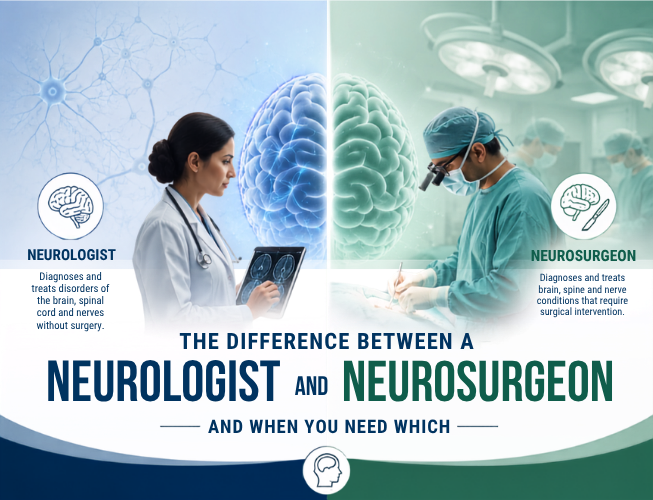
They Are Not the Same Thing
A neurologist is a doctor who works entirely without surgery. The brain, spinal cord, and peripheral nervous system all fall within their territory — but their tools are clinical. Examination. Imaging. Nerve conduction tests. Medication. Ongoing management of conditions that need monitoring and adjustment over time rather than a procedure.
A neurosurgeon started in the same place and kept going — into the operating theatre. When something inside the skull or spine needs to be physically addressed, removed, repaired, or decompressed, that is their work.
One manages. The other operates when managing is not sufficient.
When You Need a Neurologist First
More neurological problems than people expect never require surgery at all. Or at least not to start with.
Epilepsy is managed neurologically. So is Parkinson's disease, multiple sclerosis, most migraines, peripheral neuropathy, dementia, and the long recovery after a stroke. These are conditions that need a physician who understands the nervous system deeply and can build a treatment plan that adjusts over months or years.
The signs that point toward a neurology appointment — headaches that have genuinely changed in character, weakness or numbness appearing in a limb, one side of the face or body behaving differently, tremors, memory that has been noticeably slipping, dizziness that keeps returning without explanation.
A neurologist does not rule out surgery forever. They find out what is actually happening first.
When a Neurosurgeon Becomes Necessary
Some problems are structural. And structural problems sometimes need to be physically fixed.
A tumour sitting on the brain and growing. A blood vessel that has ruptured. A disc so herniated it has compressed the nerve to the point where the leg has stopped working properly. Fluid building inside the skull with nowhere to go.
These are situations where a neurosurgeon gets involved. Not necessarily immediately — not always emergency surgery on day one — but an assessment of what the problem actually is and what options exist.
Worth knowing: a neurosurgical consultation does not automatically mean an operation. Plenty of patients sit down with a neurosurgeon and leave with a monitoring plan or conservative management for now. Surgery is a tool. It gets used when it is genuinely the right one.
When Both Are Involved
Many conditions involve both specialists at different points.
Stroke comes through emergency neurology first — medication, imaging, stabilisation. If there is bleeding that requires intervention, neurosurgery steps in. A spinal tumour might spend months under neurological management before the timing for surgery becomes right. Epilepsy that will not respond to medication eventually gets a surgical evaluation — but only after neurology has exhausted what it can do first.
They are not in competition. In any hospital running properly, they talk to each other and the patient moves between them based on what the situation requires.
What to Actually Do
Do not get stuck on terminology when the symptom is happening right now.
Sudden severe headache — the worst of your life. One-sided weakness appearing out of nowhere. Speech coming out wrong. Vision that has shifted. These are emergency department situations. Not a question of which specialist to Google. Get there and let the clinical team decide.
For everything else — a symptom that has been building, something a routine check flagged, a concern sitting in the background — start with your physician. The right referral follows from there. What costs people is not choosing the wrong specialist. It is not going at all.
At Bhaktivedanta Hospital and Research Institute, neurology and neurosurgery work as one integrated team — cases reviewed together, treatment planned together, and patients not falling through the gap between two departments that should be talking. If something neurological has been on your mind, an early conversation is always the right first step.
FAQ
What is the actual difference between a neurologist and a neurosurgeon?
A neurologist diagnoses and manages conditions of the brain and nervous system through non-surgical means. A neurosurgeon operates when the condition requires physical intervention. Both specialise in the nervous system but work at different points in the care pathway.
Which one do I see for a brain tumour?
Investigation usually starts with a neurologist or general physician, then moves to neurosurgical assessment. The neurosurgeon evaluates whether surgery is needed, what kind, and when — or whether monitoring first makes more sense.
Can a neurologist help with back and spine problems?
Yes — neurologists manage nerve-related spinal conditions like sciatica and disc-related nerve compression through non-surgical treatment. When the spine requires physical correction or decompression, that is the neurosurgeon's role.
Which symptoms need emergency attention?
Sudden severe headache, one-sided weakness or numbness, speech difficulty, vision changes, or sudden confusion — these do not wait for a scheduled appointment. Emergency department, immediately.
Do neurologists and neurosurgeons work on the same patient?
Often yes — particularly for stroke, brain tumours, epilepsy, and complex spinal conditions. The best outcomes come when both are reviewing the case together rather than working in separate silos.