
In most cancers, the difference between a stage one diagnosis and a stage three diagnosis is not just medical. It is the difference between a treatment that is manageable and one that is gruelling. Between a recovery that takes months and one that takes years. Sometimes it is the difference between surviving and not.
India loses that difference more often than it should. Not because the medicine is not there. But because by the time most patients walk into an oncologist's room, the cancer has already had a significant head start.
This is not a small problem. And it is not an accident.
The Symptom That Got Explained Away
Ask most late-stage cancer patients in India when they first noticed something was wrong, and the honest answer is usually — earlier than anyone realised.
A lump that was assumed to be a cyst. Bleeding that was put down to stress or diet. A cough that lingered for months before anyone thought to investigate it seriously. Fatigue so deep it changed daily life, quietly attributed to overwork or anaemia and left at that.
Symptoms do not always announce themselves dramatically. Cancer, particularly in its early stages, is often subtle. And in a country where most people are managing demanding lives with limited time and even more limited access, subtle symptoms tend to wait.
The Barrier Nobody Talks About First — Fear
Before cost. Before access. Before awareness. There is fear.
A significant number of people in India who notice something wrong delay seeing a doctor not because they cannot but because they are afraid of what they might be told. Cancer carries a weight in the cultural imagination that makes the idea of a diagnosis feel more threatening than the symptom itself. If I do not confirm it, it is not real yet.
This is not irrationality. It is a deeply human response to something terrifying. But it is also one of the most medically costly delays in the entire journey.
Cost and Access — The Real Geography of Cancer in India
For a large portion of India's population, early cancer diagnosis is not a matter of awareness alone. It is a matter of infrastructure.
Tier two and tier three cities, rural areas, and urban low-income communities often lack access to the kind of diagnostic facilities — mammography, colonoscopy, low-dose CT scanning, biopsy services — that make early detection possible. When those facilities exist, they may require travel, time off work, and out-of-pocket expenses that a family simply cannot absorb on the chance that something might be wrong.
So people wait. They wait until the symptom becomes impossible to ignore. And by then, the window that early-stage cancer offered has often closed.
Awareness That Has Not Reached Far Enough
India has made real progress in cancer awareness over the last decade. But that progress has not reached everywhere equally.
Breast self-examination, cervical cancer screening, the warning signs of oral cancer — this information exists, is clinically proven, and saves lives where it is known and acted upon. But in large parts of India it remains either unknown or understood in a way that does not quite translate into action. Awareness without access to follow through is only half the equation.
There is also a gender dimension worth naming. Women in India delay seeking care for themselves at higher rates than men — not because they are less aware, but because the structure of many households means their health comes last. By the time permission, resources, and time align, months have passed.
What Earlier Diagnosis Would Actually Change
Stage one breast cancer has a survival rate above ninety percent in most clinical settings. Stage four drops dramatically. The same pattern holds across most solid tumours — cervical, colorectal, oral, lung. The biology of cancer does not change. But what medicine can do about it changes enormously depending on when it is found.
Earlier diagnosis does not just improve survival. It reduces the intensity of treatment needed, the financial burden on families, the time lost to recovery, and the long-term impact on quality of life.
The Bottom Line
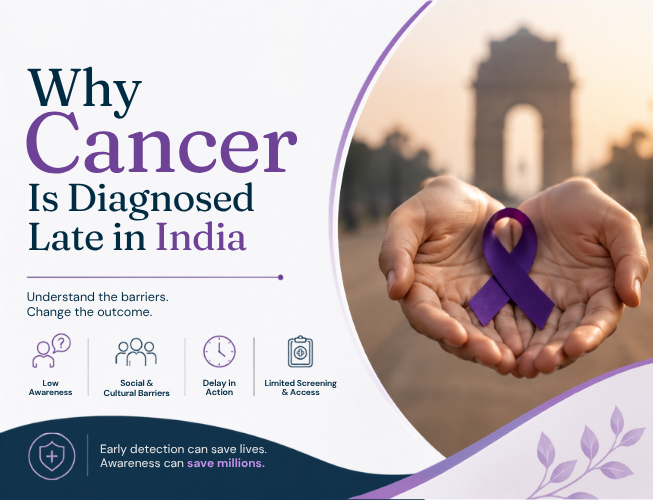
Late cancer diagnosis in India is not one problem. There are several — fear, cost, access, awareness, and a healthcare system still catching up to the scale of what it is being asked to handle.
None of these are unsolvable. But solving them starts with naming them clearly, without softening the reality of what delayed diagnosis costs people and families every single day. If something has felt wrong for a while, this is worth reading twice. Early investigation is not overreacting. It is the single most effective thing available to anyone concerned about cancer — and it costs far less, in every sense, than waiting.
FAQ
Why is cancer detected late in India compared to other countries?
A combination of factors — fear of diagnosis, limited access to screening facilities in smaller cities and rural areas, financial barriers, low awareness of early symptoms, and cultural tendencies to delay seeking care — all contribute to late-stage cancer detection being significantly more common in India than in countries with established screening infrastructure.
What are the early warning signs of cancer that should not be ignored?
Unexplained weight loss, persistent fatigue, a lump anywhere in the body, unusual bleeding, a cough lasting more than three weeks, changes in bowel or bladder habits, and sores that do not heal are among the signs that warrant prompt medical evaluation — not a wait and see approach.
Does early cancer diagnosis really make a difference to survival?
Yes — significantly. Most cancers detected at stage one or two have substantially higher survival rates and require less aggressive treatment than the same cancers found at stage three or four. Early detection is the most consistently effective tool available in cancer outcomes.
Is cancer screening available in India for common cancers?
Yes. Screening for breast, cervical, and oral cancers is available across many public and private healthcare facilities in India. The challenge is awareness, access, and uptake — particularly in non-metro areas where facilities may be limited or underutilised.
What stops people in India from getting screened for cancer early?
Fear of a positive result, cost of diagnostic tests, distance from facilities, lack of awareness about screening options, and in many cases the tendency to prioritise other family members' health above one's own — particularly among women — are the most commonly cited barriers.
Back