
Most people do not think about blood until they desperately need it. A road accident at midnight. A complicated delivery. A child with thalassemia who has been coming to the hospital every three weeks since he was four years old. In all of these moments, somewhere in the background, a doctor or a nurse is quietly checking whether the blood is there.
Sometimes it is. Sometimes the family is on the phone calling everyone they know at 2am trying to find a matching donor. That is the reality of blood shortage in India — and it is a reality that a few more voluntary donors could genuinely change.
World Blood Donor Day falls every year on June 14th. Not as a formality. But as a reminder that blood has no substitute, no factory, no algorithm that can produce it. The only source is a person who decided to give an hour of their day.
The Numbers Behind The Need
India needs close to 15 million units of blood annually. The gap between what is needed and what is actually collected is not small. And the people sitting inside that gap are not statistics — they are patients mid-surgery, mothers in labour, cancer patients three weeks into chemotherapy who cannot continue without a transfusion.
What makes this harder is that blood does not keep. Red blood cells last around six weeks. Platelets last five days. So even a good collection month does not solve next month's problem. The supply needs people coming back regularly, not just showing up once after seeing a camp banner and never again.
Can You Donate? Probably Yes.
This is where most people get stuck. They have convinced themselves there is some reason they cannot — a medication they take, a cold they had last month, that one time they felt dizzy after donating years ago.
The actual criteria are simpler than people expect. Between 18 and 65. Above 45 kilograms. In general good health on the day. That covers most adults. A nurse runs through haemoglobin, blood pressure, and pulse before every donation. If something is off that day they will tell you. You do not need to figure it out yourself beforehand.
Things that do genuinely prevent donation — active infection, certain chronic conditions, recent surgery, pregnancy, specific medications. The team at the donation centre goes through this with you. It is not a guessing game.
What It Actually Feels Like
There is a version of blood donation that lives in people's heads that is far more dramatic than what actually happens.
You arrive. Fill out a short form. A nurse does a quick check. The needle goes in — it is a pinch, genuinely just a pinch — and then you sit there for about eight minutes while it is done. After that, a biscuit, some juice, ten minutes of rest, and you walk out. The whole thing from walking in to leaving is rarely more than an hour.
Plasma is back within a day. Red blood cells within a few weeks. Most donors feel nothing different by the time they get home. A few feel a quiet kind of satisfaction that is difficult to describe to someone who has not experienced it yet.
The Things People Believe That Are Simply Not True
Donating regularly makes you weak. It does not. The body was built to handle this and recovers faster than most people expect.
You can catch something from donating. Every needle is new, sterile, used once and disposed of. The risk is zero.
O positive is too common to matter. It is actually the most transfused blood type in the country. Common demand meets common supply every single day.
Dizziness last time means never again. It almost always comes down to not eating or not drinking enough water beforehand. Fix those two things and most people donate without any issue at all.
Showing Up Once Is Good. Coming Back Is What Changes Things.
Men can donate every three months. Women every four. Someone who donates consistently over ten years contributes more than most one-time donors combined ever will.
If you have donated before — bring someone new this time. That is genuinely the most useful thing you can do on World Blood Donor Day.
This World Blood Donor Day, Mira Road Showed What a Community Can Do
While the world marked June 14th with awareness drives and social media posts, one residential society in Mira Road did something more tangible.
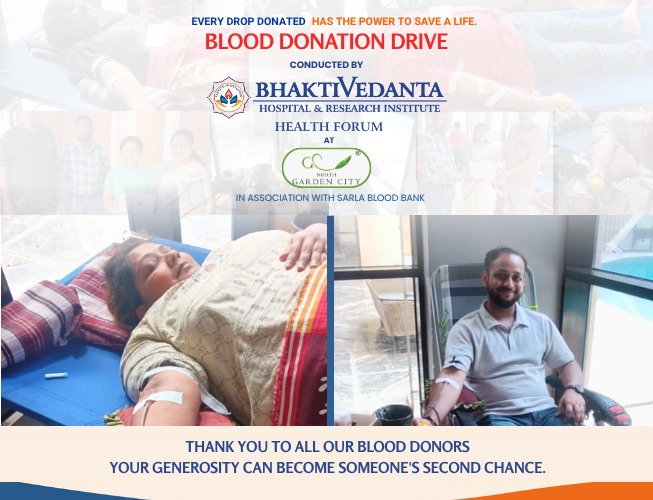
Bhaktivedanta Hospital and Research Institute, in association with Sarla Blood Bank and initiated by Bhaktivedanta Health Forum, organised a blood donation camp at JP North Garden City, Mira Road — right in the heart of the community it serves. And the community showed up.
Young professionals, middle-aged residents, senior citizens, first-time donors — they all came forward with the same quiet intention. To give. Voluntarily, without being asked twice. Many brought family members and neighbours along. Together, they turned a residential society into something that felt, for a few hours, like a place where everyone had decided — on the one day that asked for it — to actually do something.
That is exactly what World Blood Donor Day is for. Not observation. Action.
Encouraged by the response, Bhaktivedanta Hospital and Research Institute, together with Sarla Blood Bank and Bhaktivedanta Health Forum, looks forward to carrying this initiative to more communities across Mira Road and Mira Bhayandar in the months ahead. For information about upcoming camps or to register your residential society for a dedicated blood donation drive, contact Bhaktivedanta Hospital and Research Institute directly.
Find your nearest licensed blood bank or donation camp across Mumbai, Thane, Mira Road, and Mira Bhayandar. There is no better day than today to stop meaning to and actually go.
FAQ
Who can donate blood in India?
Anyone between 18 and 65, weighing above 45 kg, and feeling well on the day of donation. A quick pre-donation screening checks haemoglobin, blood pressure, and pulse — so you do not need to self-assess beforehand.
Does donating blood hurt?
There is a brief pinch when the needle goes in. After that most people feel nothing. The donation itself takes around eight minutes and the full visit wraps up in under an hour.
How often can someone donate?
Men every three months. Women every four. Platelet donation can happen more frequently depending on the individual.
What should I have before donating?
Eat something iron-rich a few hours before — dal, leafy greens, eggs work well. Drink more water than usual. Skip heavy or fatty food right before. Coming in well fed and hydrated makes the experience significantly smoother.
Why is voluntary blood donation important in India?
India faces a consistent shortfall between the blood it needs and what gets collected each year. Voluntary unpaid donors are the safest and most reliable source of blood. Regular voluntary donation is the only sustainable way to close that gap and ensure blood is available when patients need it most.